Efficiency & Creativity
Efficiency in Taiwan isn’t just speed. It’s design. 菜单, queue logic, space planning, and labor division turn a crowded morning into something workable.
Taipei
Taipei 的早单 runs like public logistics: systems are designed to move large numbers smoothly with minimal conversation. Efficiency becomes a shared rhythm that fits urban work schedules.
Tainan
In Tainan, efficiency often looks like workability rather than pure speed; systems still function, but they’re supported by people slowing down to reduce confusion and error.
Physical Space- Taipei

-
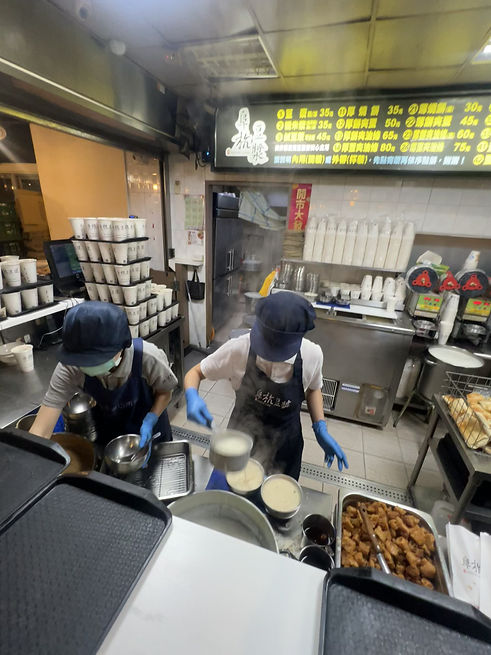
Fu Hang (Day 5): the room is divided into clear zones, kitchen, order/pickup stations, and seating, so customers move step-by-step with minimal friction.
-
Yong He-style shop (Day 1): tight line spilling outside; people already know where to stand and how to move.
-
Songshan / Li Jiang (Day 7): compact entrance and layout built for a financial district; bar-style seating for solo diners + regular seating for groups, space supports different social uses without slowing service.
Physical Space - Tainan

-
Toast shop (Day 9): larger seating area, warmer design, “stay a while” feeling; the space invites lingering compared to Taipei’s commuter rhythm.
-
Day 13 stall-like breakfast spot: looks improvised (plastic wrap boxes/bottles as “walls”), but the interior still runs like a system; small footprint, tight workflow.
菜单 System - Taipei

-
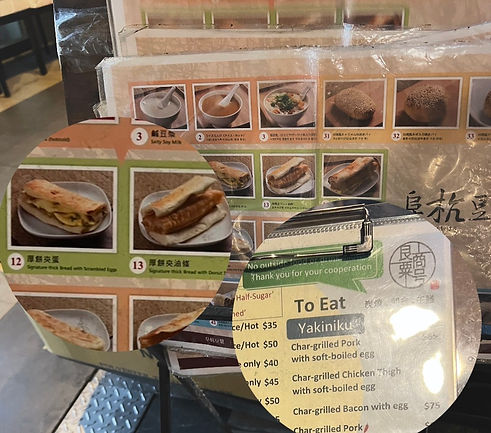
Fu Hang (Day 5): numbered menu reduces ordering to codes, faster, clearer, and more accessible across language ability.
-
Li Jiang (Day 7): English translation + pre-set sweetness rules (“half sugar/unsweetened”) + hot/iced labels, menu reduces decision fatigue and miscommunication.
菜单 System - Tainan

-
Toast shop (Day 9): English menu exists (welcoming), but it doesn’t fully translate into the rest of the process (order sheet still Chinese).
-
Day 13 stall-like shop: had an English menu “without hesitation,” showing accessibility doesn’t require a polished or touristy setting.
Ordering System - Taipei

-
Day 3 reflection: single-sheet checkbox ordering replaces long handwritten orders; reduces labour and speeds workflow.
-
Fu Hang (Day 5): station-style ordering and tray handoff; minimal explanation needed because the system tells you what to do.
-
Self-clearing (Day 5): customers separate dishes/clear trays, ordering doesn’t end at payment; customers participate in keeping the flow.
Ordering System - Tainan

-
Toast shop (Day 9): order sheet in Chinese + you had to walk back to submit/pay; flow felt less automatic.
-
But: staff stayed with you and explained patiently—ordering success depended on guidance, not just signage.
-
Day 13 stall-like shop: clear division of labor (two in kitchen, one handling payment/orders) shows tight workflow even in informal spaces.
Summary of The Analysis
Taipei: In Taipei, space is often engineered for throughput, clear zoning and predictable movement.
In Tainan, space more often balances efficiency with comfort and social time, while still keeping a functional workflow.
Taipei uses space to move bodies efficiently; Tainan uses space to hold people longer, without collapsing the system.

Use of Physical Space
菜单 Systems
菜单 are doing cultural work: they’re not just listing food; they’re designing legibility. Taipei tends to “systematise” legibility (codes, rules, structure).
Tainan often relies on a mix of partial translation + human support.
Taipei builds legibility into the menu; Tainan often completes legibility through people.
Ordering systems reveal what a city assumes about its customers.
Taipei systems assume customers will self-navigate quickly.
Tainan systems allow more room for interaction and correction.
Taipei ordering minimises 对话; Tainan ordering often uses 对话 to prevent confusion and mistakes.